Gjør det lettere å prate
om følelser

Institusjon:
NTNU - Institute for Design
Samarbeidspartner:
Trondheim Kommune
Emne:
Design 3 - Menneskesentrert design
Tidsperiod:
August - Desember 2023
Team:
Leo Holtan Bøckman
Tuva Lie Enersen
Tuva Eide
Emma Ditaranto
Verktøy:
Intervju
Workshops
Research
Personas
Crazy-8
Prioriteringsmatrise
Wireframe
Prototyping
Testing
Pitch
Dette forsøkte vi å løse
Hvordan kan vi gjøre det lettere for gutter til å søke psykisk helsehjelp hvis de trenger det?
FHI rapporterte om dobbelt så høy risiko for selvmord blant menn enn kvinner [1]. Vi ville ta en forebyggende tilnærming og designe for tenåringsgutter i alderen 13-19 år.
Vi designet et spill til klasserommet for å engasjere elevene til å prate om følelser helt uformelt. Målet er å gjøre det lettere for guttene å selv kjenne etter når de trenger hjelp til å løse indre konflikter.
Game setup
Rules
Lets play
Finale
Spillregler:
Læreren kan sette seg inn i spillet på forhånd
Digital Guide i Sanntid:
Leder læreren og klassen gjennom spillet
Fysiske kort og kortholdere:
Elevene interagerer gjennom kort
Start
Let’s Play
Students select cards from five picture categories that best align with their secret card. Categories are presented in this order: color, form, animal, candy, and meme. The time limit encourages intuitive choices and opens internal reflections on emotions.
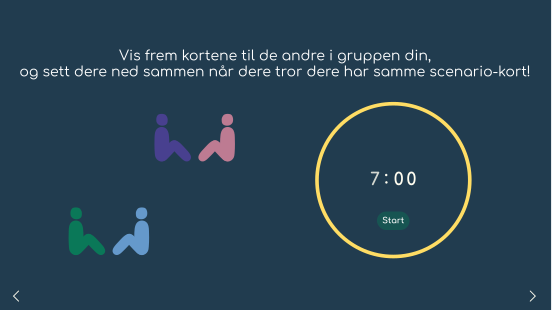
Students silently find their match by comparing card choices. Matches are finalized with non-verbal agreement, and matched pairs sit down to indicate completion.
Students reveal their secret cards to their match and discuss their card choices. Guided by the digital timer, each category is discussed for two minutes, fostering reflection on emotional associations.
The teacher records successful matches on a scoreboard. While scoring adds fun, it is secondary to the game’s core goal of emotional dialogue.
In the second round, the game works the same way, but the secret cards only show a scenario without naming an emotion. This means that students must decide for themselves what emotion fits the situation. This makes the game a bit different and encourages deeper thinking and discussion about thairemotions.
Finale
Students and the teacher engage in a class discussion about what they learned. The teacher explains that winning is not the purpose; instead, the game is about understanding and verbalizing emotions with other things than words.
The game encourages students to ask each other, “What color are you today?” as a fun and simple way to talk about their feelings. This helps them connect with others and understand emotions better. By playing the game, students learn how talking about feelings can improve their mental health and make it easier to support each other.
3/3
Introduction
This is a game designed for middle and high school students to promote emotional expression and understanding through engaging and interactive gameplay. Students are encouraged to discover and reflect on emotions, both their own and those of others.
The game revolves around communication through five picture categories: color, form, candy, memes, and animals. It is specifically structured for classroom use and is best played in groups of 10–14 students. This teacher’s manual, along with a digital guide, provides the necessary resources for facilitating the game effectively.
The game consists of four main sections: Game Setup, Rules, Let's Play, and Finale. Each section is outlined in detail below.
Game Setup
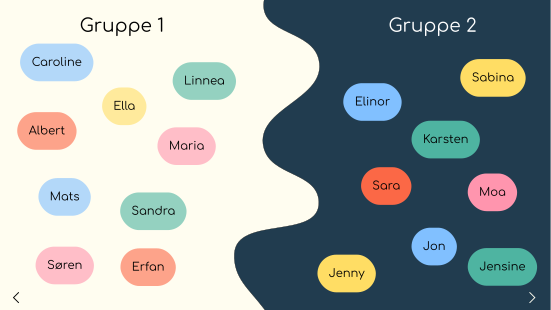
Before the session, the teacher registers the names of all students in the “Add names” function on the digital platform. When playing the game use the divide tool to divide students into balanced groups. The names will be appear on the screen, making it easy for the students to see which group they belong to. Arrange table groups based on the number of students per group with the secret card. Display the digital guide on a screen for the entire class to follow.
Rules
The game involves group competition, but the primary goal is emotional reflection, not scoring points. Students will follow these rules: When the screen shows “dark mode,” no talking is allowed. This applies during card selection and the pairing process. Each student is assigned a secret card containing a scenario and/or emotion, which they must keep confidential. Students can communicate non-verbally (thumbs-up/down gestures) to find their match. Students have one minute per card category and seven minutes for pairing.
When both students agree on a match, they sit down and wait for the 7-minute timer to run out. If some students fail to find a partner within the given time frame, they must form pairs afterward, even if they do not agree on the pairing.
2/3
Game setup
Rules
Lets play
Finale
Game setup
Rules
Lets play
Finale
Sånn gjorde vi det
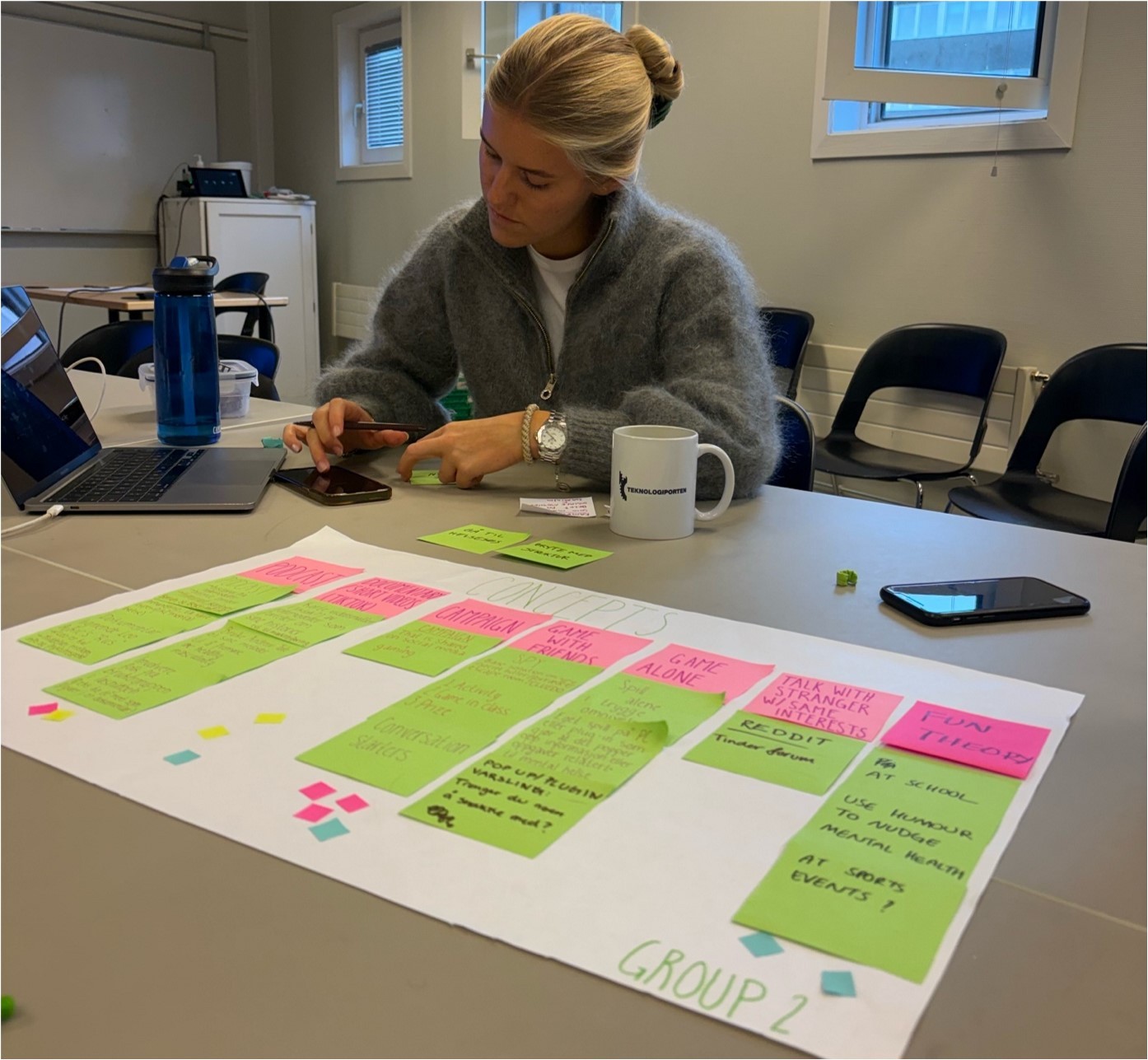
Gjennom forskning og intervjuer fant vi at gutter sjelden snakker om problemer, uansett hvor små de er, for å unngå å skape oppstyr. I tillegg føltes ansikt-til-ansikt-kommunikasjon ukomfortabelt for å uttrykke følelser, selv om det fungerte fint for jentene.
Lærere uttrykte at de tydelig kunne se guttenes utfordringer, fordi det påvirket dynamikken i klasserommet. Når lærerne prøvde å snakke med dem, oppdaget de at guttene hadde problemer med å uttrykke hva de følte.
“Jeg vil ikke gjøre en stor greie ut av det” - gutt (14)
“Jeg ser at de sliter, men vet ikke helt hvordan jeg kan hjelpe de” - barneskolelærer
Sånn fungerer spillet
To tilfeldige spillere i en stor gruppe får det samme hemmelige kortet med en følelse og et scenario.
Spillerne kan kun kommunisere gjennom bilder ved å velge fem kort innenfor kategoriene farge, form, dyr, godteri og memer som de forbinder med følelsen. Bildene er alle forskjellige, så de må tolke hverandres valg gjennom kombinasjonen av bilder.
Målet er å finne hverandre for å vinne poeng. Gruppen med flest poeng vinner. Målet er å øve på å oppfatte og snakke om følelser, uansett hvor liten situasjonen er.



Dette oppnådde vi
→ Designet et verktøy til bruk av lærerne
→ Designet et spill baser på kognitiv psykologi
→ Fasiliterer kommunikasjon mellom alle kjønn
→ Åpner for en løs og ledig prat om følelser